
Victoria County Court Records After Arrest
After a Victoria County jail arrest, the record trail splits into two related paths. The sheriff and jail side records the arrest, booking, custody date, bond field, holds, and jail status. The court side records the legal case: complaint, information, indictment, charge language, settings, warrants, bond orders, dismissals, pleas, judgments, and final dispositions. A person may appear on the jail roster before a court case is fully visible, especially near the start of an arrest.
The custody side belongs with Victoria County jail inmate records, while booking photos belong with Victoria County jail roster mugshots. Court records after arrest are different because they track what the State of Texas files and what the court does with each count. That distinction matters when a booking charge later becomes a different filed charge, when a charge is reduced, or when one count is dismissed while another remains pending.
Victoria County Odyssey Court Records
The official online court-record route is Victoria County Odyssey Public Access. Research found the portal as the county's public access path, but the visible fields can vary by Odyssey function and public configuration. Use cautious search choices, then confirm document access and certified-copy needs with the correct clerk. Some document images or case details may be controlled by access rules even when an index result is visible.
The court portal screenshot comes from Victoria County Odyssey Public Access.
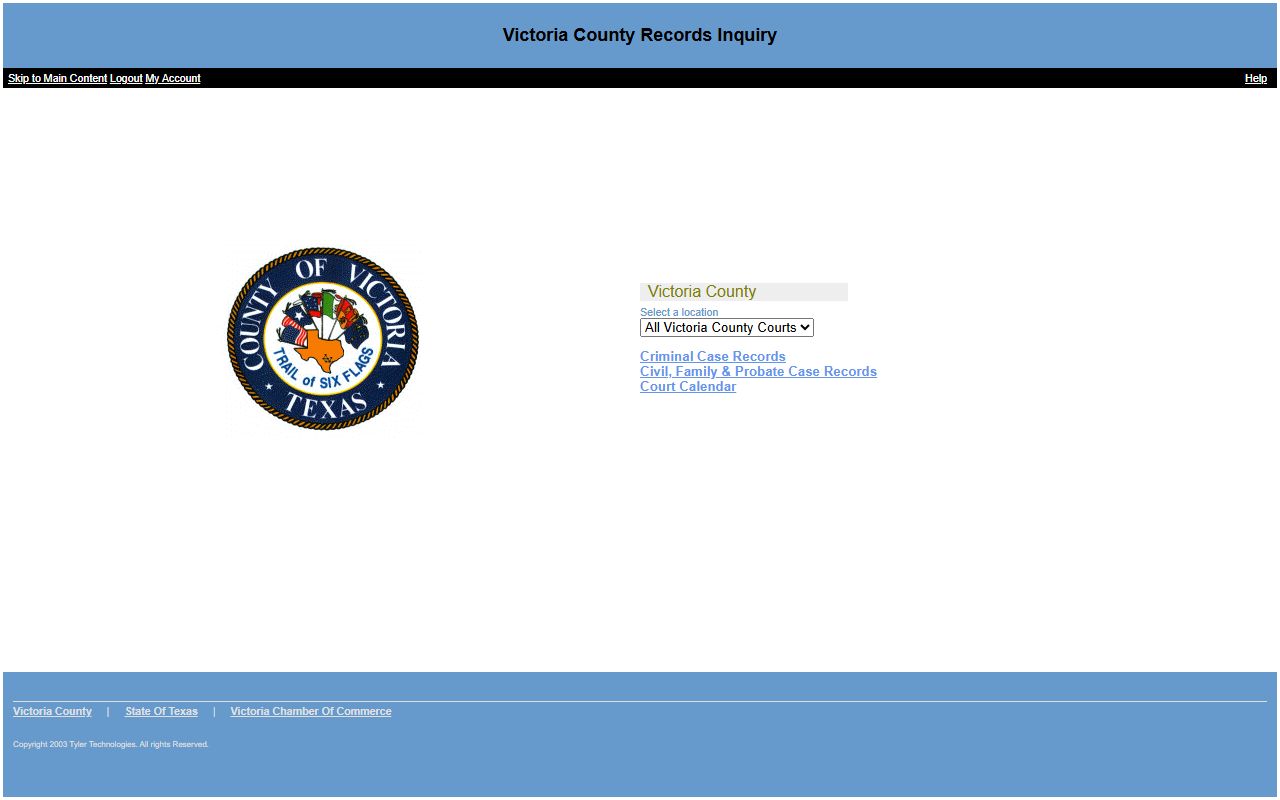
Odyssey is the proper place to look for filed case records after an arrest, while the jail roster remains the custody and booking lookup.
| Field / Search Path | Type | Required | Notes |
|---|---|---|---|
| Case number | Text | Optional / search-specific | Use if the roster charge grid, clerk, or court notice gives a case number. |
| Party / defendant name | Text | Optional / search-specific | Search by defendant name when no case number is known. |
| Court / case type | Dropdown or filter | Search-specific | Use criminal, misdemeanor, or felony categories if the portal exposes them. |
| Filing date / date range | Date or filter | Optional if exposed | Helpful when several people share a name or when the arrest date is known. |
| Search / Submit | Button | N/A | Runs the query in the selected Odyssey search function. |
Victoria County Clerk Roles
The clerk path depends on the case level. The Victoria County District Clerk is the key office for district-court and felony-level records. The Victoria County Clerk is the key office for county-level misdemeanor, probate, civil, and public records. If an arrest begins with a misdemeanor allegation, the county clerk route may matter. If the case becomes a felony, district clerk records are usually the more relevant path.
The District Clerk page was captured from the official Victoria County District Clerk information page.
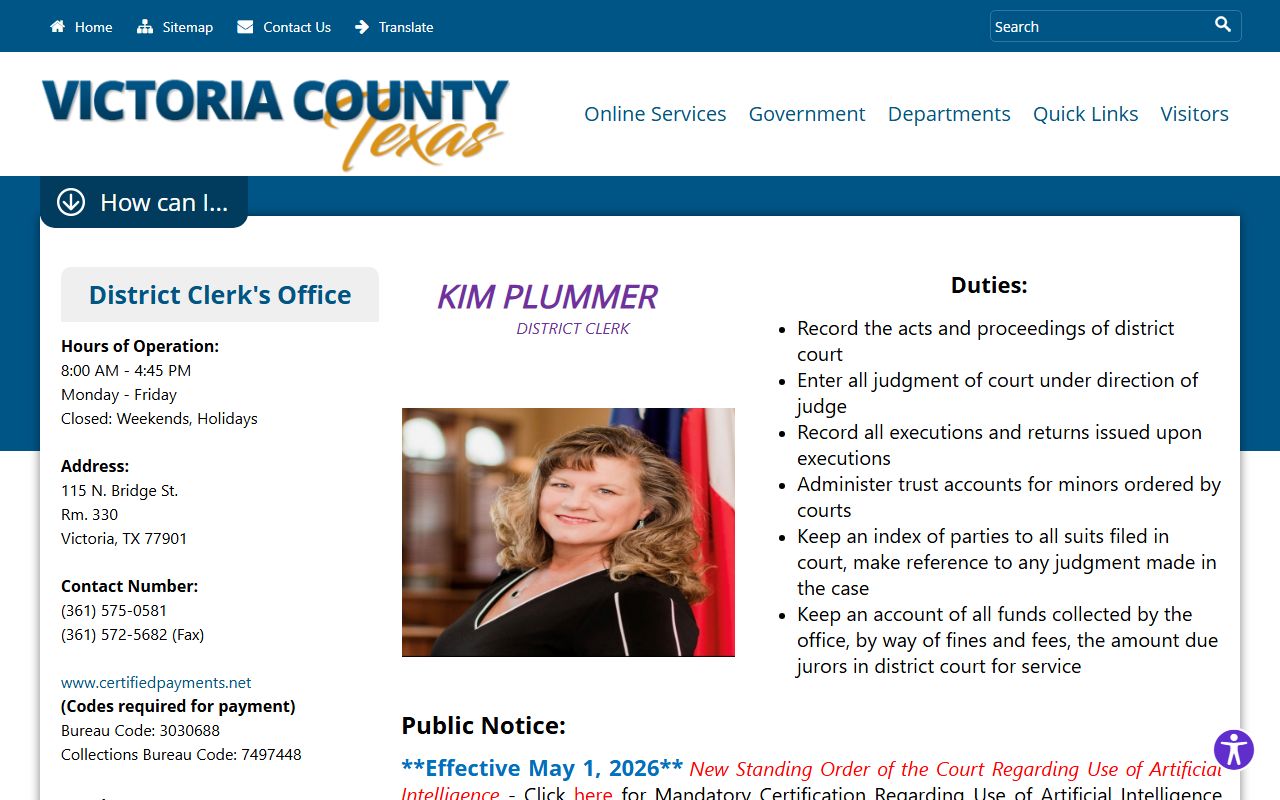
Clerk offices are the better source for copies, court-file access, and records-request instructions when an Odyssey index does not answer the question.
| Office | After-Arrest Record Role | Use When |
|---|---|---|
| District Clerk | District-court and felony case records. | The arrest leads to a felony case, indictment, district-court setting, or district-court disposition. |
| County Clerk | County-level misdemeanor and other county-court records. | The arrest leads to a county-court misdemeanor case or county-level records request. |
| Sheriff / Jail | Booking, custody, roster, incident, and arrest-side records. | The question is who is in custody, whether a person was booked, or whether an older booking record can be requested. |
| Odyssey Public Access | Public court index and case search path. | The question is case number, filed charge, setting, status, or disposition. |
District Attorney After Arrest
The Victoria County District Attorney is the local prosecutor office for criminal cases after arrest. The DA does not run the jail roster. The office evaluates law-enforcement submissions, files or rejects charges, handles plea and disposition decisions, and represents the State of Texas in prosecutions within its jurisdiction. A booking charge can be the starting point, but it is not always the charge that appears in the court record.
The DA's office page is shown from the official Victoria County District Attorney source.
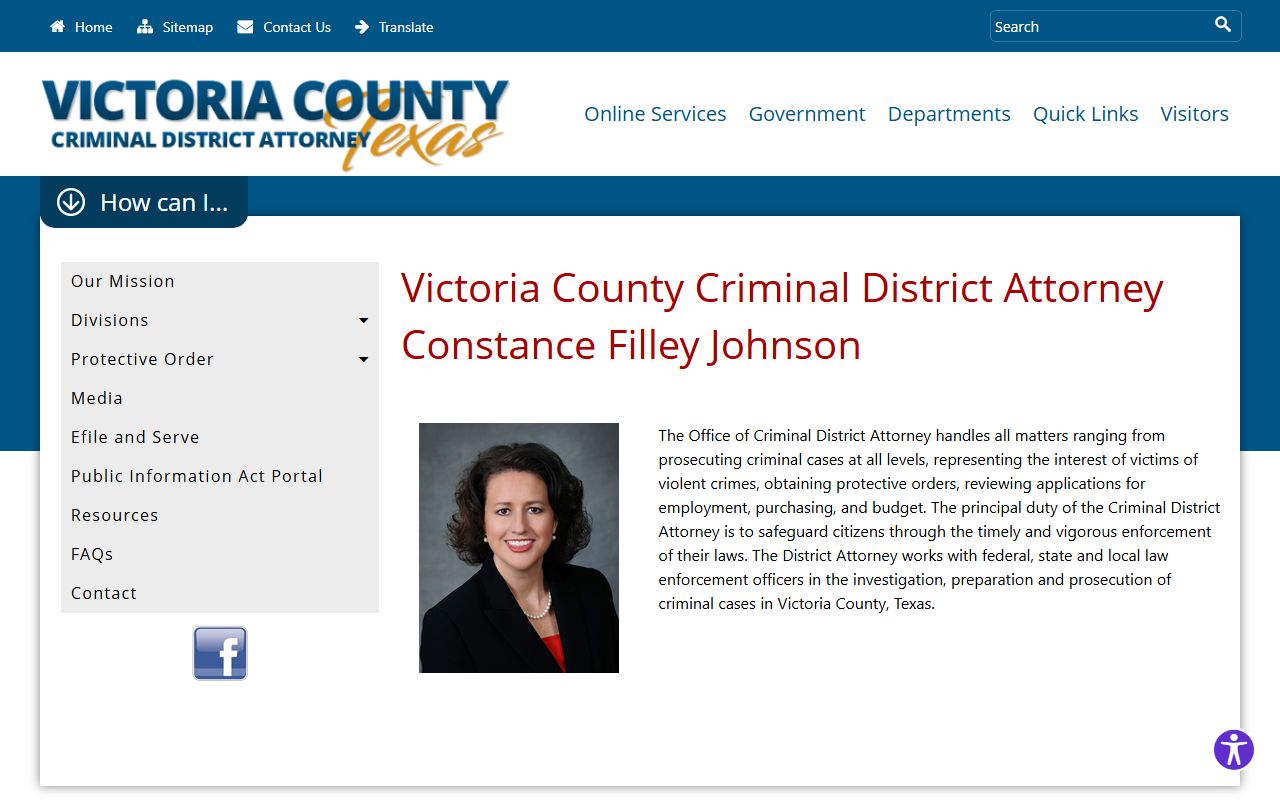
For court records after a jail arrest, DA information helps explain how a booking can become a filed complaint, information, indictment, amended charge, dismissal, or plea.
Victoria County Arrest to Court
The sequence is practical: arrest, booking, magistrate or bond step, prosecutor review, formal charge, court case, then later settings and disposition. Texas Code of Criminal Procedure Chapter 17 controls bail and personal-bond concepts, while Chapter 15 is useful for warrant-to-arrest context. The court record begins to matter most after a prosecutor or grand jury turns the arrest-side facts into filed legal allegations.
- Booking: jail staff enter arrest charge, custody status, bond fields, and hold information into the jail system.
- Magistrate or bond step: rights, bond, release conditions, or no-bond status may be addressed under Texas procedure.
- Prosecutor review: the District Attorney may file, decline, reduce, enhance, or present a felony case to a grand jury.
- Formal charge: a complaint, information, or indictment creates the charge record that the court tracks.
- Court case: Odyssey and the clerk offices become the main sources for case number, settings, charge changes, and disposition.
Victoria County Charging Documents
Charging papers are the bridge between an arrest and a court record. The exact document depends on the offense level and prosecution path. A complaint may support early proceedings or a misdemeanor case. An information is a prosecutor-filed charge used in many non-indictment matters. An indictment is a grand-jury charging instrument, commonly tied to felony prosecution. These words should not be used as if they all mean the same thing.
| Document | Who Files or Returns It | Common Use | Why It Matters |
|---|---|---|---|
| Complaint | Often sworn by an officer or used by a prosecutor early in the case. | Early criminal filing or misdemeanor path. | Can start or support the court record after arrest. |
| Information | Prosecutor. | Many misdemeanor or non-indictment prosecutions. | States the charge the State chooses to pursue. |
| Indictment | Grand jury. | Serious felony prosecution. | May replace or refine the earlier booking charge with grand-jury language. |
Victoria County Charge Status
Charge status can change many times between arrest and final court record. Booking data may list one description, while the filed case uses another. The prosecutor may amend language, reduce severity, dismiss a count, add a count, or abandon a charge. A court may later show deferred adjudication, acquittal, conviction, or dismissal. The status term should be read in the case context, not as a broad statement about a person's full criminal history.
| Status | What It Means | Record Caution |
|---|---|---|
| Pending | The case or count is open with no final disposition. | Check future settings and bond conditions. |
| Amended | Charge language or count details changed. | The booking charge may no longer match the filed court record. |
| Reduced | Charge severity was lowered. | Look at the final judgment or plea record before drawing conclusions. |
| Dismissed | The case or count ended without conviction on that charge. | Dismissal is not the same as automatic expunction. |
| Acquitted | A not-guilty finding was entered. | Eligibility for later record relief depends on Texas law and court orders. |
| Convicted | A guilty plea, verdict, or other conviction disposition was entered. | Use the court judgment, not the old booking row, for final status. |
| Deferred adjudication | Texas disposition where adjudication may be deferred subject to court terms. | It is not the same as immediate conviction in every context. |
| Nolle prosequi / abandoned | Prosecutor no longer pursues a charge; terminology may vary. | Confirm with the clerk because local docket wording can differ. |
Note: A Victoria County jail arrest can produce several charge-status entries before one final court disposition appears.
Victoria County Bond and Warrants
Bond appears in both custody records and court records after a jail arrest. The inmate locator can show a bail or fine amount and a per-charge bail amount or type. That field is useful, but it does not override holds. A bench warrant, blue warrant, parole issue, other-agency hold, no-bond order, or immigration detainer may keep a person in custody after one charge appears bondable.
No official public active-warrant database with field-level search was located in the reviewed Victoria County sources. Use the Sheriff's Office main line, the jail roster, Odyssey, and the correct clerk office rather than third-party warrant aggregators. A warrant arrest can later produce a jail record, a hold entry, a court setting, or a new case record depending on why the warrant was issued.
| Bond or Warrant Term | Meaning After Arrest |
|---|---|
| Cash bond | Money paid directly under the applicable court or jail procedure. |
| Surety bond | A licensed bail bond company posts bond and assumes the surety obligation. |
| Personal / PR bond | Release on promise to appear, often with court-set conditions. |
| No-bond hold | Release is unavailable until the warrant, court order, or agency issue changes. |
| Bench warrant | A judge-issued warrant, often tied to failure to appear or violation of a court order. |
Charges Versus Convictions
A charge is an accusation or filed allegation. A conviction is a later court outcome. Victoria County court records after arrest may show both, but they appear at different stages. The roster's charge grid may be useful for a fast custody check, while the court docket and judgment are needed to know whether the case ended in dismissal, plea, acquittal, conviction, deferred adjudication, or another disposition.
| Point | Charge | Conviction |
|---|---|---|
| Stage | Arrest-side or prosecutor-filed allegation. | Final or later court outcome after plea, verdict, or judgment. |
| Proof level | Can arise from probable cause or prosecutor filing. | Requires a guilty plea, verdict, or qualifying adjudication. |
| Where seen | Jail roster, complaint, information, indictment, Odyssey case index. | Judgment, disposition, sentencing entry, or final court record. |
| Main caution | May be changed, reduced, or dismissed. | Should still be verified with the clerk or certified record when used formally. |
Sealed and Expunged Records
Public access can change after a case is dismissed, sealed, made subject to nondisclosure, or expunged. Texas Code of Criminal Procedure Chapter 55 governs expunction of qualifying arrest records. Texas Government Code Chapter 411 and Code of Criminal Procedure Chapter 66 are relevant to criminal-history record information. A person should not assume a dismissal erases every public record without a court order.
| Point | Sealed / Nondisclosed | Expunged |
|---|---|---|
| Public visibility | Restricted from ordinary public access when a valid order applies. | Removed or treated as not existing for qualifying purposes under the order. |
| Government access | Some agencies may retain limited access depending on law and order terms. | Access is more restricted, but exact effect depends on the expunction order. |
| Eligibility | Depends on Texas nondisclosure rules, disposition, and court action. | Depends on Chapter 55 and the case's facts and outcome. |
| Practical step | Check the court order and clerk record. | Check whether an expunction order was granted and served on agencies. |
County Records and Criminal History
Odyssey and the Victoria County clerk offices are the proper places to track a county case after a jail arrest. Statewide criminal-history data is different. Texas DPS criminal-history dissemination is governed by Government Code Chapter 411 and related law. It may require separate process, eligibility, identifiers, and fees that are not the same as a free county court search. Do not treat a statewide background product as a substitute for the live Victoria County docket.
Texas Government Code Chapter 552, the Texas Public Information Act, supports public requests to local offices, but exceptions still matter. Juvenile records, sealed records, expunged records, medical or mental-health details, victim information, and active investigative material may be withheld or redacted. Public court records after a jail arrest can answer many case questions, but they do not make every related law-enforcement detail public.
Request Victoria County Arrest Records
When the question is about the arrest or booking document instead of the filed case, use the Victoria County Sheriff's Office records request path. Include enough detail to identify the record, such as the person's name, date of arrest or booking if known, case or incident number if known, record type, contact information, and delivery preference. Do not invent form fields that the official page does not publish.
For filed criminal cases, use Odyssey, the District Clerk, or the County Clerk. For prosecution media releases, use the DA pages, but do not use DA media as the only court-record source. The DA media page also routes mug shot questions to the Sheriff's Office, which reinforces the split between booking-photo requests and court case records.
Important: Court records after arrest are not consumer reports and should be verified with the clerk before formal use.